

Community Costs Something
What the Methodist movement and a Tuesday night run club have in common

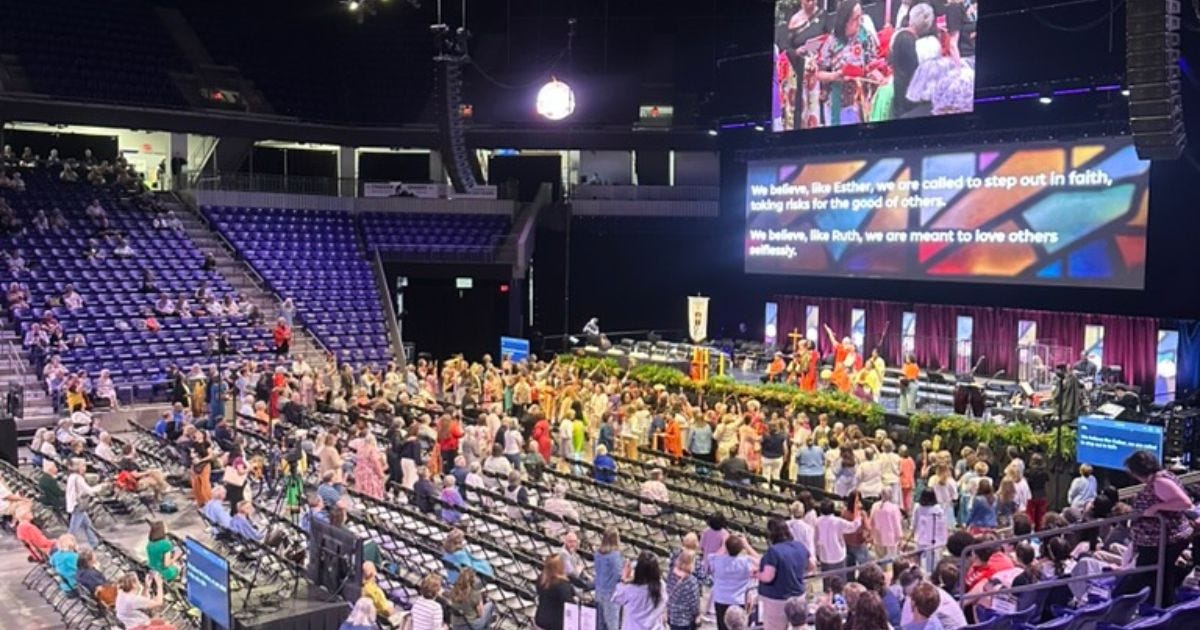
I am moving as a part of a greater movement.
Last week, I was in Harrisonburg, Va — and this line kept moving in my mind.
In the mountains of Virginia. At what United Methodists call Annual Conference, the yearly gathering of clergy and laity from across the state. A room full of people who have tied their lives, in some form, to the same tradition, the same questions, the same uncomfortable act of showing up together year after year.
The theme this year: Reclaiming the Heart of Methodism.
I walked in with anticipation.
And guardedness.
Holding both at once. The more I’ve grown into this vocation, the harder it becomes to reconcile the state of the institution with the call itself. But there I was, because the calling has been the same — and I have never loved the church for what it is, but always for what it could be.
What God created it to be. Community.
The Movement
Through my time at Annual Conference, I reflected on what the Methodist movement actually was when it began. The fledgling groups that made up the early movement had nothing to do with institutions or committees. It was people in motion. Wesley in the open fields, preaching to miners with coal dust on their faces because the established church had decided they weren’t worth the trouble. Rule-benders. People who believed that holiness wasn’t something you polished alone in a pew. It was something you worked toward together, imperfectly, on the move.
Unfortunately, it often feels that’s not the version you encounter now.
More often than not, the version encountered at Annual Conference carries history. It carries hurt. It carries real disagreement about who belongs and how we move forward. You walk in knowing that. You walk in hopeful and braced, and that’s not cynicism. I think it is how we learn and grow as a community. Confronting the uncomfortable to find shared life together.
Real community has never been the comfortable version.
It’s always been the chosen version.
I come back to that every time I want to step back. The alternative to staying in the room is walking away, letting the movement move without you. And isolation has a cost too. It’s just a quieter one. Most people don’t notice they’ve paid it until returning feels impossible.
Community is never easy. But it matters more than it costs.
The Other Kind
I’ve been thinking about movement all week. My mind keeps wandering to the other kind. The kind I find comfort in.
Running has shaped how I move through the world, not just literally, but as a posture. You don’t stand still waiting for conditions to be perfect. You lace up and go, even when the route is uncertain and the mile is hard.
Running has taught me something about staying in motion: you adjust, but you don’t stop. You hit a wall and you don’t quit. You recalibrate your pace and keep going. The goal isn’t to never struggle. It’s to keep going.
There’s a Wesleyan word for that: sanctification. Holiness isn’t a destination. It’s a direction. You don’t arrive. You move toward it. Together.
RunSomeMo
My running community is called RunSomeMo. We meet Tuesday nights and Saturday mornings. We are not a perfect group.
Yet, as I reflect on my presence with them, I don’t show up because it’s always easy. I show up because it’s my community. And community, like running, is something you choose to stay in even when it gets hard.
There’s a moment on a long run, and you know it if you’ve been out there long enough, where you could justify stopping. Everything in you wants to. But you look around at the people moving alongside you, and something holds. Not obligation. Something more like belonging.
That’s a movement too. Small, local, made of ordinary people in running shoes. And it’s practicing the same thing Annual Conference is practicing. Just on different roads.
I am moving as a part of a greater movement.
That line means more now than it did when I first wrote it down. It was always carrying both things at once.
Not working toward a perfect community. Not in the church, not on the road. Working toward each other. That’s the direction. And the direction is enough.
What movement are you part of?
What does it cost you to stay in it?
Is it worth it?